This topic delves into the fascinating origins of pickleball, tracing its invention in 1965 on Bainbridge Island, Washington, by Joel Pritchard, Bill Bell, and Barney McCallum. It explores how the game evolved from a spontaneous effort to entertain bored children using various sports equipment, blending elements of badminton, tennis, and ping-pong, and its subsequent growth from a backyard pastime into a globally recognized sport.
The Unlikely Rise of a Backyard Sensation: A Deep Dive into the History of Pickleball
In a world saturated with high-impact, intensely competitive sports, there's one that has quietly, then explosively, captured the hearts and paddles of millions: Pickleball. It’s a game often described as a blend of tennis, badminton, and table tennis, played with a paddle and a plastic ball on a court roughly the size of a badminton court. Its simple rules, social nature, and accessibility have made it the fastest-growing sport in America.
But where did this quirky game come from? Was it invented by a marketing genius? Or a clandestine government project to promote physical activity? The truth, as it often is, is far more charming and wonderfully mundane. So, grab a refreshing drink, find a comfortable seat, and let's embark on a journey back to the summer of 1965, to an island off the coast of Washington state, where the legend of Pickleball was born.
The Genesis: A Summer Day on Bainbridge Island (1965)
Our story begins in the summer of 1965 on Bainbridge Island, a picturesque retreat just a ferry ride from Seattle. Joel Pritchard, then a state representative and later a congressman, and his friend Bill Bell, a successful businessman, found themselves facing a common parental dilemma: bored children.
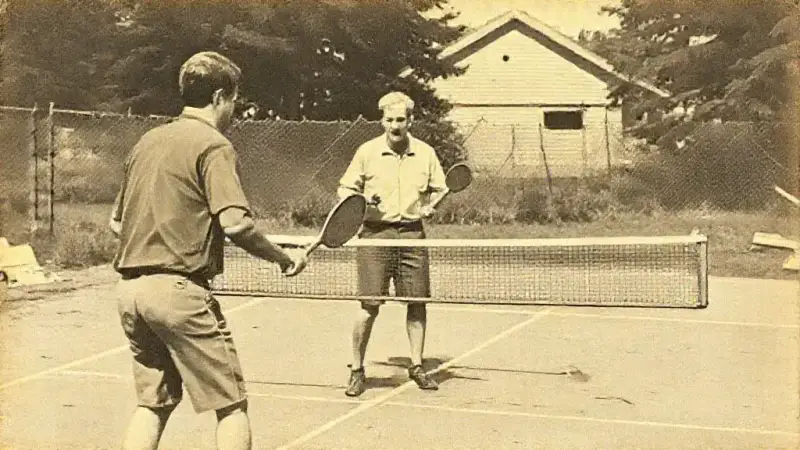
It was a Saturday afternoon. The kids were restless, complaining of nothing to do. Pritchard’s property had an old badminton court, but they couldn't find a full set of badminton rackets. Instead, they scrounged up some ping-pong paddles and a perforated plastic ball (the kind used for wiffle ball).
With these makeshift tools, they headed to the badminton court. The net, of course, was too high for their small paddles and plastic ball, so they lowered it to 36 inches. This initial improvisation, born out of necessity and a desire to entertain, laid the foundational elements of what would become Pickleball.
They started hitting the ball back and forth, quickly realizing the limitations and opportunities of their cobbled-together equipment. The plastic ball didn't bounce much, and the short paddles made it difficult to cover the full court. So, they improvised further, developing rules on the fly. The goal was simple: get the ball over the net and keep it in play.
Naming the Game: The Tale of the Dog (or the Boat?)
As the summer progressed, Pritchard, Bell, and another friend, Barney McCallum, who joined them shortly after, continued to refine the game. They created specific rules, focusing on fairness and making it enjoyable for all ages. But a new game needs a name, doesn't it? And here, the history gets a little hazy, with two delightful origin stories vying for supremacy.
The most widely accepted, and charming, tale involves Joel Pritchard's dog, Pickles. Pickles, a cocker spaniel, apparently loved to chase the plastic ball and "pickle it" (run off with it) when it went out of bounds. The story goes that the game was named after this enthusiastic canine companion.
However, Joel Pritchard's wife, Joan, offered an alternative explanation. She claimed that the game was named after the term "pickle boat," which refers to the last boat to finish in a crew race, usually made up of oarsmen chosen from the leftovers of other boats. Given the sport's origins—cobbled together from leftover equipment and rules—this explanation certainly has a poetic resonance.
Regardless of which story you prefer (or perhaps both played a role!), the name "Pickleball" stuck. It was quirky, memorable, and perfectly suited for a game that was, at its heart, an accidental invention of fun.
Early Evolution and the First Official Court
The initial makeshift game quickly gained traction among the families and friends on Bainbridge Island. The low net, the forgiving plastic ball, and the small court made it accessible to people of all ages and skill levels. It was less physically demanding than tennis but offered more exercise than ping-pong.
Barney McCallum, known for his woodworking skills, took the lead in crafting the first dedicated paddles. Initially, they were simple pieces of plywood, but they were a significant upgrade from the ping-pong paddles. These early paddles, hand-cut and sanded, became the prototype for what we use today.
The first "official" Pickleball court was built in Barney McCallum's backyard in 1967. This was a dedicated space, designed specifically for the game, marking a significant step from casual backyard fun to a recognized activity. The lines were painted, the net was permanently installed, and the rules were becoming more concrete.
Word of mouth began to spread beyond Bainbridge Island. Friends of the families introduced it to their own communities, primarily in the Pacific Northwest. Its appeal was undeniable: it was easy to learn, provided a good workout, and fostered a strong sense of community and friendly competition.
Formalization and Rule Development (1970s)
As Pickleball’s popularity grew, so did the need for standardized rules. The informal agreements made during those first summers weren't enough to govern a sport played by an increasing number of people across different locations.
In 1972, a corporation was formed to protect the creation of the sport, and in 1976, the first official rulebook for Pickleball was published. This was a crucial step in legitimizing the sport and ensuring consistency across different play environments. The rules established the dimensions of the court, the height of the net, the service rules, and, most importantly, the non-volley zone (or "kitchen"), which prevents players from smashing the ball from close to the net, encouraging dinking and strategic play. This rule is often cited as one of the unique aspects that gives Pickleball its distinct character.
The 1970s also saw the development of more sophisticated equipment. The original plywood paddles started giving way to more advanced composite materials. Manufacturers began to recognize the growing market and started producing paddles and balls specifically designed for Pickleball, improving the playing experience and further solidifying its identity as a standalone sport.
In 1976, the first known Pickleball tournament was held in Tukwila, Washington. While small by today's standards, it was a landmark event, signaling the sport's transition from a recreational pastime to a competitive endeavor.
The Quiet Decades: Steady Growth (1980s - Early 2000s)
For a couple of decades, Pickleball experienced steady, albeit relatively slow, growth. It wasn't a sudden explosion, but a quiet, organic expansion. The sport continued to thrive primarily in the Pacific Northwest, with pockets of enthusiasts emerging in other parts of the country.
A significant driver of this growth was its adoption by senior communities and recreational centers. The low-impact nature of the game, combined with its social aspect, made it incredibly appealing to older adults looking for an active and engaging way to stay fit. It offered a great cardiovascular workout without the strain on joints often associated with tennis or running.
During this period, the USA Pickleball Association (USAPA) was established in 1984. Its mission was to promote the growth and development of Pickleball on a national scale. The USAPA became the official governing body, standardizing rules, sanctioning tournaments, and providing resources for players and organizers. This institutional support was vital in laying the groundwork for the sport's future boom.
Despite these efforts, Pickleball remained largely under the radar for the general public. It was a beloved niche sport, cherished by its growing community, but far from mainstream recognition. This was before the age of instant information and viral trends, so its spread relied heavily on word-of-mouth and local initiatives.
The Digital Age and Exponential Growth (2010s - Present)
The early 2010s marked a pivotal turning point for Pickleball. The rise of social media, online video platforms, and accessible digital communication created the perfect environment for a sport like Pickleball to finally break out.
Suddenly, people could easily find videos explaining the rules, demonstrating techniques, and showcasing exciting rallies. Online communities formed, allowing players from different regions to connect, share tips, and organize games. The low barrier to entry for learning the sport meant that these digital resources quickly translated into real-world participation.
What truly propelled Pickleball into the stratosphere was its universal appeal. It's a game that grandparents can play with their grandchildren, teenagers can play with their parents, and seasoned athletes can play alongside complete beginners. Its inclusive nature became its superpower.
The USAPA, now known as USA Pickleball, redoubled its efforts to promote the sport. They invested in grassroots initiatives, sanctioned more tournaments, and actively worked to establish official courts in communities across the nation. The numbers speak for themselves: from an estimated 100,000 players in 2010, the sport surged to over 5 million players by 2022, consistently being named the fastest-growing sport in America.
Professionalization and Mainstream Recognition
With millions of recreational players, it was only a matter of time before professional circuits emerged. The past few years have seen the establishment of professional tours, drawing top talent and offering significant prize money. Organizations like the PPA Tour (Professional Pickleball Association) and Major League Pickleball (MLP) have brought the sport to a wider audience, with matches broadcast on major sports networks and streaming platforms.
Celebrity endorsements have also played a role. From sports legends to Hollywood stars, many prominent figures have publicly declared their love for Pickleball, further boosting its profile. This mainstream recognition has led to increased investment in court development, equipment innovation, and coaching programs.
The boom has not been without its challenges. The demand for courts often outstrips supply, leading to crowded facilities and even debates over converting tennis courts. Noise complaints from residents living near Pickleball courts have also become a surprising consequence of its popularity, as the distinct "thwack" of the paddle hitting the plastic ball can be quite loud.
The Enduring Appeal and Future of Pickleball
So, what is it about Pickleball that has allowed it to not just survive, but thrive, for nearly six decades?
- Accessibility: It's easy to learn, requires minimal equipment, and the smaller court size means less running than tennis.
- Social Connection: The small court and frequent rotations foster conversation and camaraderie. It's as much a social gathering as it is a competition.
- Health Benefits: It provides a great low-impact cardio workout, improves agility, reflexes, and hand-eye coordination.
- Intergenerational Fun: It truly is a sport for all ages, bridging generational gaps and allowing families to play together.
- Community: Pickleball communities are known for being welcoming and supportive, eager to teach newcomers and integrate them into the game.
Looking ahead, the future of Pickleball seems incredibly bright. There's talk of Olympic inclusion, continued global expansion (it's gaining traction in Canada, Europe, and Asia), and further professionalization. The innovation in paddle technology, ball design, and court construction will undoubtedly continue.
From a simple desire to cure summer boredom on an island, Pickleball has evolved into a global phenomenon. It’s a testament to the power of improvisation, the joy of play, and the enduring human need for connection and activity.
So, whether you're a seasoned "pickler" or someone who's just heard the name, the story of Pickleball is a compelling one. It reminds us that sometimes, the greatest inventions come from the simplest moments and the most unexpected circumstances. Perhaps it's time you grabbed a paddle and joined the fun – you might just become part of the next chapter in this incredible story.