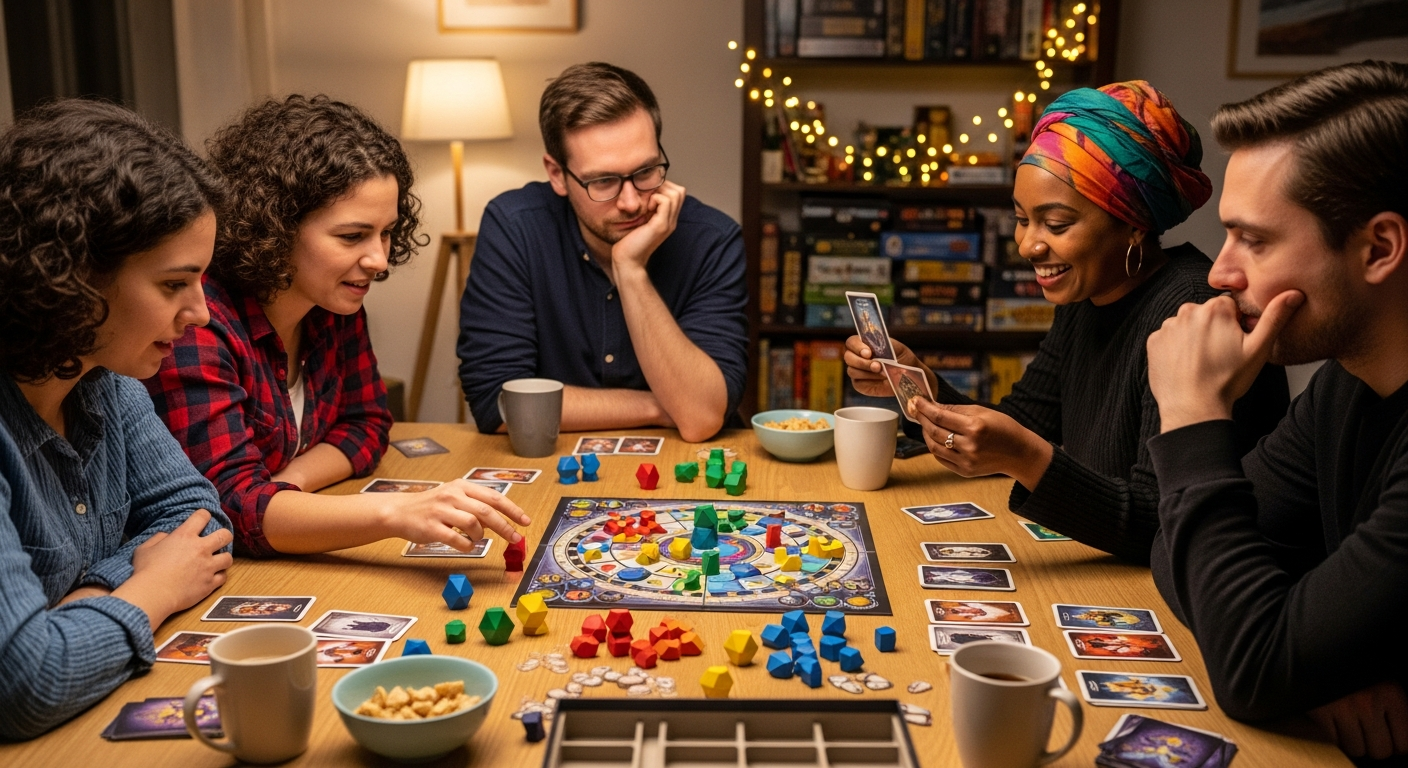
Tired of the same old classics? Dive deep into the world of tabletop gaming with our curated list of five genuinely underrated board games designed to challenge, surprise, and delight even the most seasoned hobbyists. Discover the hidden gems that deserve a spot on your next game night!
For the true board game aficionados among us, the thrill of discovery is almost as satisfying as a perfectly executed combo. We've all played the gateway games, mastered the classics, and even delved into the sprawling epics. But what about the games that quietly excel, the ones that consistently deliver memorable experiences but somehow fly under the radar?
This isn't a list for the casual player; this is for you, the passionate hobbyist, always seeking that next unique mechanic, that ingenious design, or that compelling narrative that elevates a mere pastime into an art form. Get ready to level up your game night as we unveil five genuinely underrated board games that deserve your attention.
1. Innovation (by Carl Chudyk)
Why it's underrated: Often overshadowed by more visually opulent or thematic games, Innovation is a deceptively simple card game that explodes with strategic depth, chaotic interactions, and emergent combos. Its abstract nature and initial learning curve might deter some, but beneath the surface lies a brilliantly designed civilization-building game unlike any other.
What makes it special: Each of the 105 unique cards represents a historical innovation, belonging to one of five colors and ten eras. Cards have multiple effects – they can be played into your 'score pile', 'splayed' (placed overlapping) to gain ongoing benefits, or 'tucked' for end-game scoring. The 'splaying' mechanism is genius, creating an engine of abilities that combine in unpredictable ways. The game's power curve is steep, leading to incredible swings and 'take-that' moments that are frustratingly brilliant. It's a game about adapting, exploiting, and enjoying the glorious chaos.
2. Glen More II: Chronicles (by Matthias Cramer)
Why it's underrated: While its predecessor was a cult classic, Glen More II often gets overlooked in a crowded field of Euro-style tile-laying games. It refines and expands upon an already solid foundation, offering a rich, modular experience that provides immense replayability and strategic depth.
What makes it special: This game features a unique time track mechanism where the player farthest back on the track always takes the next turn, allowing for clever tactical decisions about when to take powerful tiles versus grabbing multiple weaker ones. You'll build out your Scottish clan's territory, acquire resources, develop landmarks, and breed livestock. The 'Chronicles' modules add layers of complexity, from historical figures with special powers to whisky distillation and even raiding. It's a masterclass in elegant design, offering satisfying engine-building and spatial puzzling without overwhelming complexity.
3. Ethnos (by Paolo Mori)
Why it's underrated: Ethnos is an area-control game from a renowned designer that, despite its vibrant components and streamlined gameplay, doesn't always get the recognition it deserves. Perhaps its fantasy theme feels generic to some, but don't let that fool you – the core mechanisms are anything but.
What makes it special: At its heart, Ethnos is a brilliant blend of set collection and area control. Players collect sets of 'tribe' cards (each tribe having a unique special ability) to play as 'bands', which allow them to place influence tokens on the board. The twist is that you can only play one band per turn, and any unused cards from your hand are discarded to a public area, ripe for other players to snatch up. This creates a constant tension between building a strong hand and denying valuable cards to your opponents. The tribal powers add immense variety, ensuring that each game unfolds differently and demands flexible strategies.
4. Bruges (by Stefan Feld)
Why it's underrated: Stefan Feld has a prolific output, and while games like Castles of Burgundy and Trajan are household names for hobbyists, Bruges often gets less buzz. Yet, it's a wonderfully elegant and engaging card-driven Euro that showcases Feld's knack for point salads and difficult decisions.
What makes it special: The core of Bruges lies in its multi-use cards. Each card can be used in one of five ways: to gain workers, to build canals, to mitigate threats, to hire a person (each with a unique ability), or to build houses. Deciding how to best utilize each card you draw is agonizingly fun. Add to this a robust economy, a charming theme of building up a medieval city, and the constant threat of disasters, and you have a game that offers consistent strategic depth without feeling overly heavy. It's a prime example of Feld's accessible yet complex design.
5. Concordia (by Mac Gerdts)
Why it's underrated: Concordia is often lauded within specific circles but perhaps isn't as universally recognized as some of the heavier, more complex Euros. Yet, for its elegance, depth, and sheer replayability, it's an absolute masterpiece that deserves a place in every hobbyist's collection.
What makes it special: Concordia is an economic strategy game about Roman expansion, but it's remarkably free of luck and direct conflict. Its brilliance lies in its action selection mechanism: players have a hand of personality cards, and on their turn, they play one card to perform an action (e.g., build a market, move colonists, produce goods). The 'Tribune' card allows you to pick up all your played cards, which is the only way to re-use them. This creates a fascinating rhythm and timing puzzle, as you plan your turns multiple steps ahead. The game is all about efficient route building, resource management, and understanding how different actions scale over time. It's easy to learn but offers endless strategic possibilities, making it a truly timeless design.
So, there you have it – five exceptional board games that might not always hog the spotlight but promise to deliver rich, engaging experiences for the discerning gamer. Don't let their 'underrated' status fool you; these titles are masterpieces in their own right, waiting to be discovered and celebrated. What hidden gems do you think deserve more love? Share your picks in the comments and let's keep leveling up our game nights!